

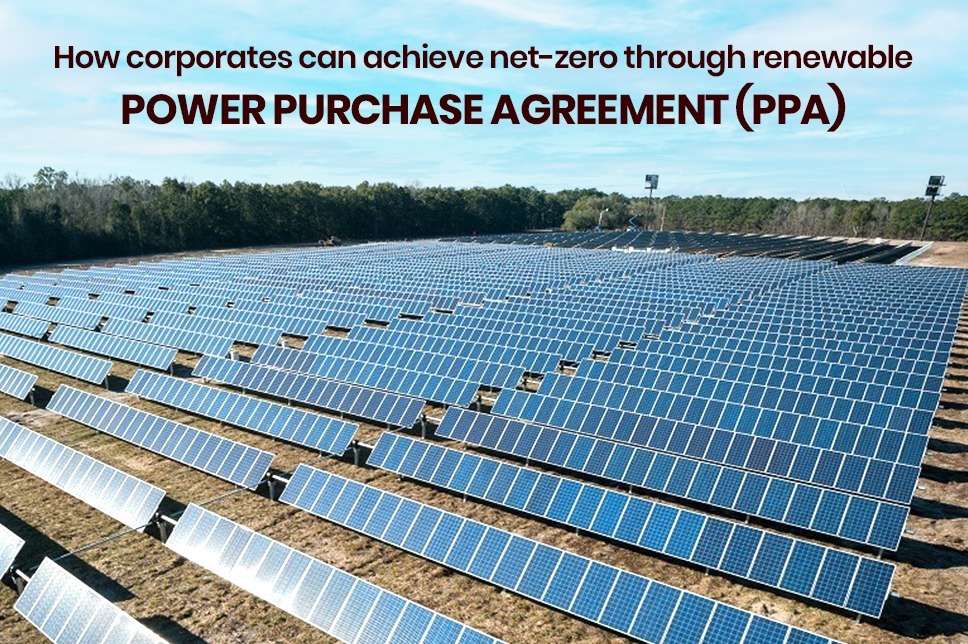
How Corporations Can Achieve Net-Zero Through Renewable Power Purchase Agreement (PPA)
When your businesses aim for net-zero emissions, aligning with an industrial solar company in Agra will be a wise move. A Renewable PPA allows corporates to go green without making a heavy capex (capital expenditure) and meet their requirements for renewable energy, while contributing to the development of green infrastructure, reducing their carbon emissions.
What is the Corporate Renewable PPA?
A Corporate Renewable PPA is an agreement where a developer (here, it’s an industrial solar company in Agra) builds, owns, and operates the solar facility and agrees to sell their power output to a corporate buyer at an agreed-upon price and rate. The average duration of this model is generally 10–25 years, providing predictability and consistency to both sides.
This means no up-front costs (CapEx) for you, as the developer will pay for and carry out the installation of the system, and all that you pay in respect to its use is consumption.
Why Corporations Are Choosing PPAs to Hit Net-Zero
1. Cost-Effective and Predictable Energy
PPA rates are typically 20%–40% lower than grid electricity, delivering substantial OPEX savings.
2. Protection Against Price Volatility
By locking it for a long-term tariff, corporations safeguard themselves from fluctuating utility rates and energy market shocks.
3. No Maintenance Headache
The industrial solar company in Agra handles all operations — system maintenance, performance monitoring, and cleaning — so the business can focus on its core operations without worrying about solar upkeep.
4. ESG & Net-Zero Alignment
PPAs empower corporations to claim Scope 2 emissions reductions, reinforcing their net-zero journey. and strengthens the sustainability credentials and makes companies more appealing to ESG-conscious investors.
5. Financing & Risk Mitigation
The Long-term PPAs make solar projects more bankable. With predictable cash flows, developers find it easier to raise funds, while companies avoid the risks of owning the asset themselves.
6. Supporting Renewable Growth
Corporations entering PPAs contribute to the financing of new solar capacity — helping scale up India’s clean energy infrastructure.
The Role of an Industrial Solar Company in Agra amplifies the benefits of a PPA. Here’s how:
Local Expertise & Execution:
A solar company based in or serving Agra has deep knowledge of local land, grid interconnection, and regulatory requirements, which means smoother feasibility studies and faster project development.
Customized Solutions:
When your business needs a rooftop plant, a ground-mounted project, or an open-access PPA structure, the industrial solar company in Agra can design a model that fits your energy demand and sustainability goals.
Transparent Billing & Allocation:
Your solar partner will set up metering and billing structures so you receive clear, accurate invoices aligned with your PPA contract.
Scalability & Expansion:
As your energy needs grow, a reliable solar partner can help scale capacity without renegotiating entirely new contracts — ensuring your net-zero strategy stays on track.
Strategic Impact: How PPAs Help Corporations Hit Net-Zero
1. Emission Reductions:
When companies lock in a long-term tariff, they are protecting themselves from utility rate fluctuations and shock waves in the energy market.
2. Financial Forecasting:
Lock-in tariffs result in predictably priced energy, which reduces risks associated with fluctuating finances and increases the opportunities for long-term planning.
3. Credible Green Claims:
Long-duration PPAs bolster credibility in sustainability reporting, helping companies provide verified renewable energy use.
4. Investor Confidence:
PPA clean-energy procurement has the potential to enhance a company’s appeal to investors focused on ESG and the long-term resilience of their investment.
Real-World Validation
PPAs are not just theoretical — many Indian companies are already leveraging them. For example, businesses report fixed PPA tariffs between ₹4–5/unit, far lower than typical grid rates. Meanwhile, renewable project developers gain financial security from these long-term contracts.
As India’s corporate renewable energy market grows, even new models like virtual PPAs (VPPAs) are gaining traction. These allow companies to financially support renewable projects without physically taking delivery of the power — enabling net-zero claims across multiple locations.
Conclusion
For the companies that are aiming for net-zero emissions, a well-negotiated Renewable PPA with an industrial solar company in Agra offers a pragmatic, risk-mitigated, and cost-efficient path. It unlocks clean energy access, delivers financial predictability, supports ESG goals, and scales your sustainability journey.
By collaborating with a dependable industrial solar company in Agra, corporations can invest in their future — not just in infrastructure, but in long-term impact. Contact GrunPower today to explore how a customised PPA can help your business move decisively toward net-zero.